
 Go straight to the download: the funding panel prompts.
Generally funders receive a lot more applications for trial funding than they can fund, which means funding panel members have to make decisions not only about whether a trial is informative, but which grant applications to reject.
This means asking questions about the submitted applications. Ideally the questions being asked should be the same for all applications to support consistent decision-making.
We have prepared two sets of questions that funding panels can ask about funding applications for trials. Panels may already be asking all or some of these questions; our lists are simply prompts to remind the panel about key questions.
We’ve divided the prompts into two lists:
- A list of 6 key questions that should always be asked, even when time is short, to make judgements about likely trial informativeness.
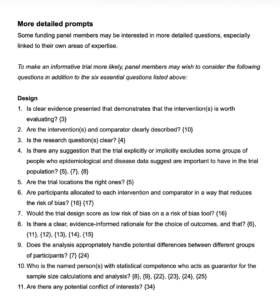
- The 6 questions plus a more comprehensive list of questions that can be used by panels, or by peer reviewers when making judgements about how informative a trial is likely to be.
The questions are based on the questions included on the INFORM Structured Grant Form for Trials. The questions could still be used even if a funder does not used the structured grant form, although we think the evaluation process will be easier, faster and more effective if both the prompts and the INFORM Structured Grant Form for Trials are used together.
The short list of 6 questions is given below. The numbers in curly brackets link to the question numbers on the INFORM Structured Grant Form for Trials. Of both the structured form and these prompts are used, panel members would know exactly where to look in the submission trial application to get the answer to the prompt question.
The 6 essential but brief prompts for funding panel members
To make an informative trial more likely, panel members should always reassure themselves that justifications for the following are in place for each trial they consider:
- Is there a clear, evidence-informed rationale for why the trial is needed {3}, {4}
- Is there a clear, evidence-informed justification for who the trial participants will be and how they will be identified {7}
- Is there a clear, well-justified explanation for the number of participants in the trial {8}
- Is there a clear, evidence-informed rationale for the choice of outcomes, and that he trial is collecting these outcome data at the right time in the right way {11}, {12}, {13}, {14}, {15}
- Is there a convincing, evidence-informed description of why trial delivery is feasible {18}, {19}, {20}, {21}
- Is it completely clear that the team has the appropriate statistical and methodological competence to design, deliver and analyse the study {8}, {9}, {22}, {23}, {24}, {25}
Generally speaking, to reduce research waste, it is better to have staged grant processes where applicants are initially only asked for brief, but key, information. Most applications will be rejected at this stage, but the work required from applicants and funders in these early stages should be modest. This means applicants and panels do not waste time on applications that have little chance of being funded because their likely informativeness is poor. Later stages of the funding process ask for more details, but applicants now have a much better chance of being funded so the extra work is justified.
We think the list of 6 key questions could be used to structure a short Stage 1 grant proposal. The actual questions asked of applicants could be some of those on the structured grant form although a Stage 1 form should be much shorter than the full INFORM Structured Grant Form for Trials.